
Where it all started
Adam started out selling coffee from a Piaggio Ape, before Tamp & Grind had any shops. The machine on it was dual-fuel, so it could switch to gas when the power ran low.
He's now got three shops, and wanted to get back out to events. He was buying a VW ID. Buzz to move stock between the shops in the week, and wanted the same van to serve coffee at weekends. But this time he didn't want gas or a generator anywhere near it.
"I don't want to run a generator. I want it all off lithium iron."Adam Moseley, Tamp & Grind Specialty Coffee
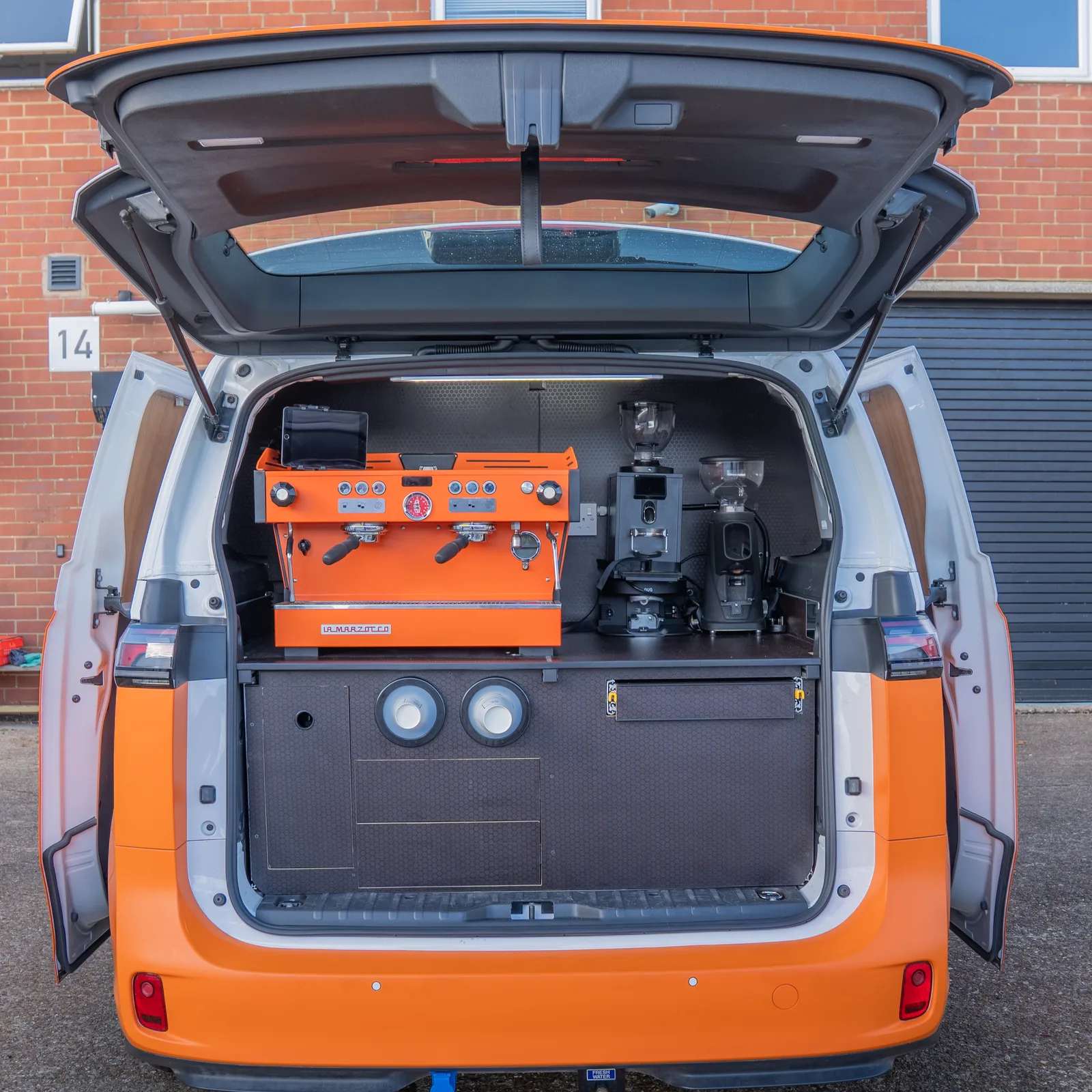
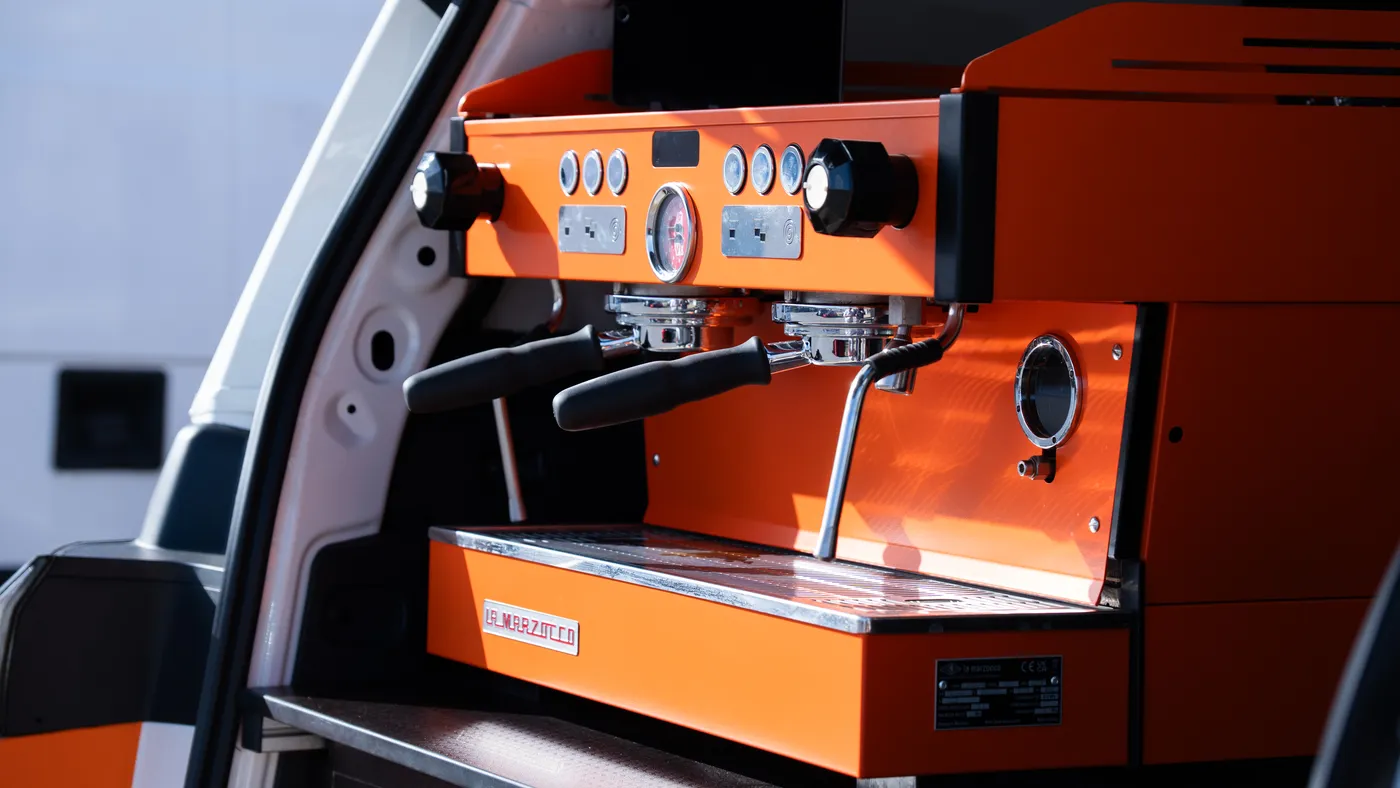
He told us he never thought a proper espresso machine could run off-grid without a generator. And his isn't a small one, it's a two-group La Marzocco. So the question was: can it run a full day's trading on lithium?
Watch the build
The all-electric coffee van: VW ID. Buzz
We started with the numbers
Normally we'd start with a layout. Not this time. If the power didn't work, nothing else mattered, so we started with the numbers. Our first quote was just the electrics, and we showed Adam all the working: how much power the machine uses, how much a six-hour day needs, and how much weight the van can carry. He got back to us the same evening.
"Thank you for taking the time to complete this comprehensive and clear quote. I really like the way it's laid out and makes it very easy to read and understand."Adam Moseley
Then Adam came back with his own numbers, and they changed a few things.
His machine actually pulls 4,600W when it's heating up, more than we'd planned for. So Adam spoke to his machine installer, who could knock 1kW off the steam boiler. The machine takes a bit longer to recover after a rush, but the system can carry a full day. Adam was happy with that.
He asked if two bigger batteries would do instead of three. We ran the numbers for a cold winter morning, when lithium gives you less, and two came up just short. So we stuck with three and showed him why.
Then we checked the charging from the van itself. We'd originally specced two 50 amp DC chargers to top the batteries up while driving. Volkswagen's technical figures said otherwise, so we went down to one, and the saving came off Adam's quote.
"Having checked against Volkswagen's technical figures, we can only draw a maximum of 30 amps off the auxiliary battery. We could have put in a 30 amp Orion, but they're big, chunky and produce a lot of heat. So we stuck with the 50 amp XS, which handles heat far better, and rolled it back to draw 30 amps, as per the spec."Mark Cropley, founder, Wildbox Adventure Vehicles
| What | Figure |
|---|---|
| Machine | La Marzocco Linea PB, two group. 4,600W heating as delivered. System designed around 3,600W |
| Trading day | Six hours. Our estimate about 11.2kWh, range 9.5 to 12.8kWh depending on how hard it's worked. Includes warm-up, two grinders, fridge, summer ice machine and losses |
| Battery bank | 17.7kWh nominal. About 12.3kWh usable on a cold winter morning, which is why there are three batteries, not two |
| Charging | One overnight charge on an off-peak tariff per trading day. About four hours to refill from a 16A hookup. About 350W back while driving |
| The limit | Two event days back to back with no power anywhere would run short on the second afternoon. We told Adam that up front |
Built around the way Adam works
Adam knows how a coffee service runs far better than we do, so we built the van around him. He came down to the workshop, and we sent him the layout drawing that evening. He only changed one thing: the till needed to go under the counter, not on the pull-out.
After that he measured everything himself: his grinders, his syrup bottles, and the crates he moves stock in. He was really clear the crate shelving had to go behind the driver. On the wrong side, it was no good to him. He even offered to bring a crate in so we could build around the real thing.
A lot of the good ideas were his. He wanted pastries on show, but an open display at an outdoor event is a magnet for wasps, so we gave it a clear sliding door. He asked for a raised floor so the crates slide straight in, and suggested a lift-out hatch over the space underneath. That hatch is now how we get to the water tank and pump. We offered him a roof fan and he said no, from his own experience of trading. Fair enough, he knows best.
The one real bump came on paper, before anything was cut. The fridge changed three times in two days. The first one didn't get cold enough and the next was out of stock. Every change moved the worktop height, so we redrew the counter each time rather than patching it up.
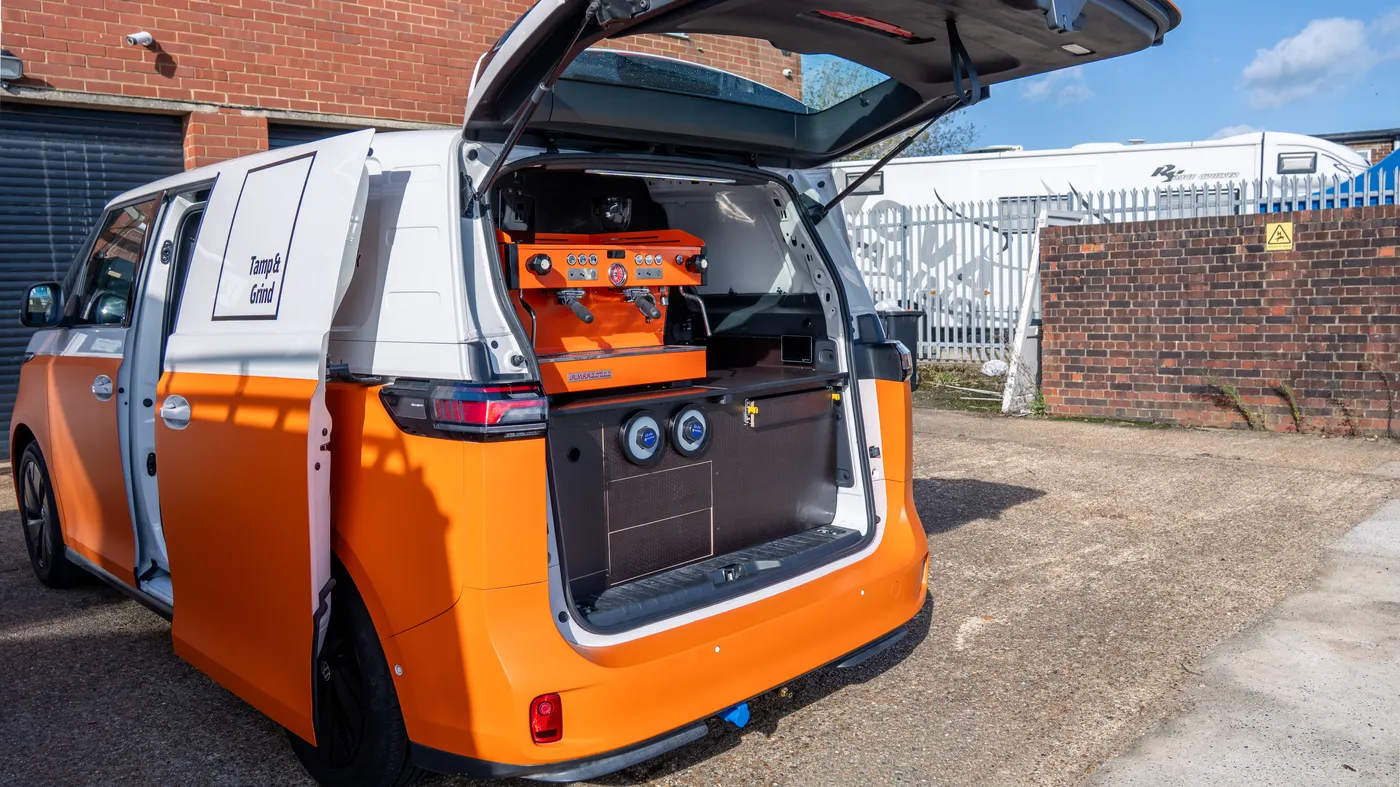
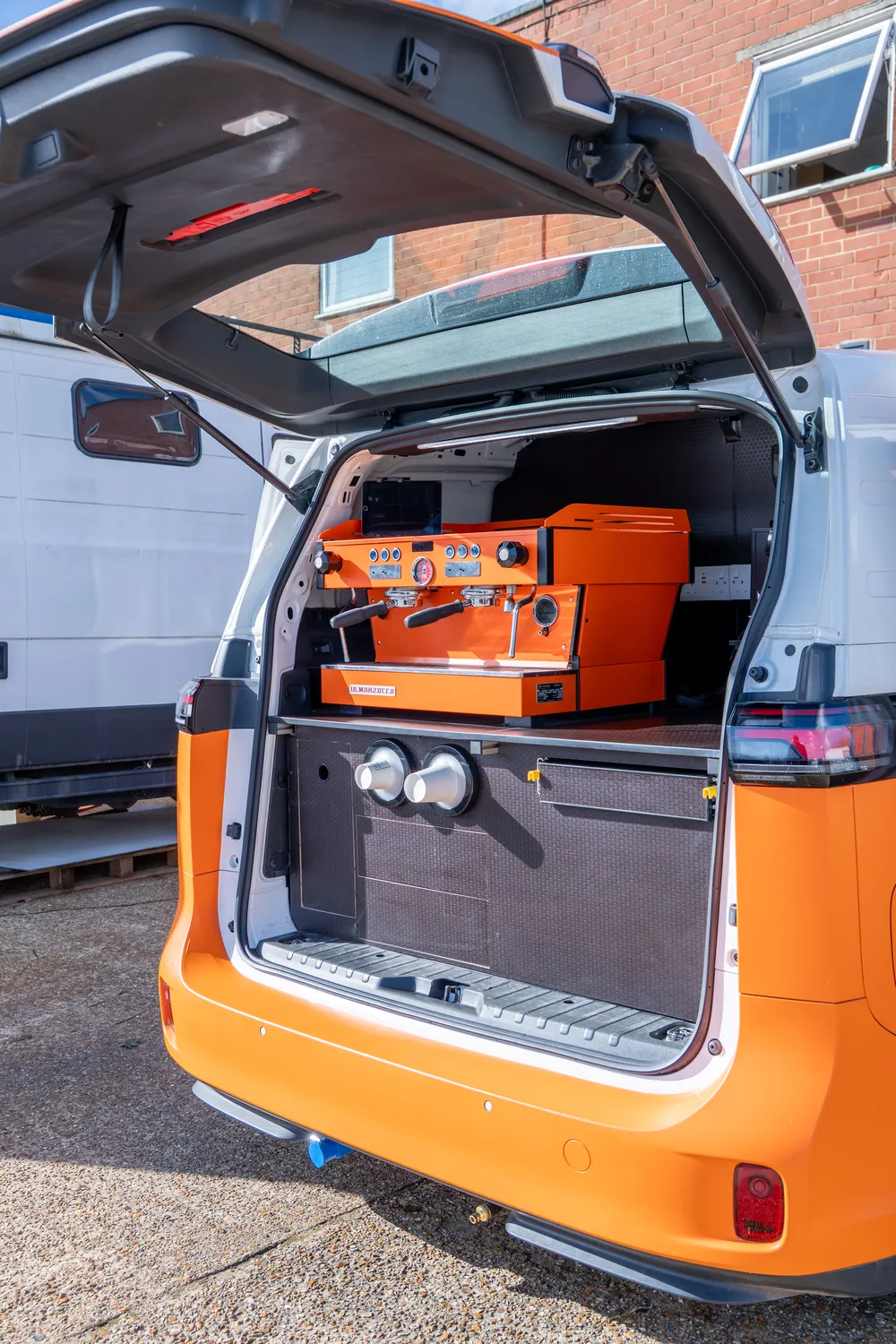
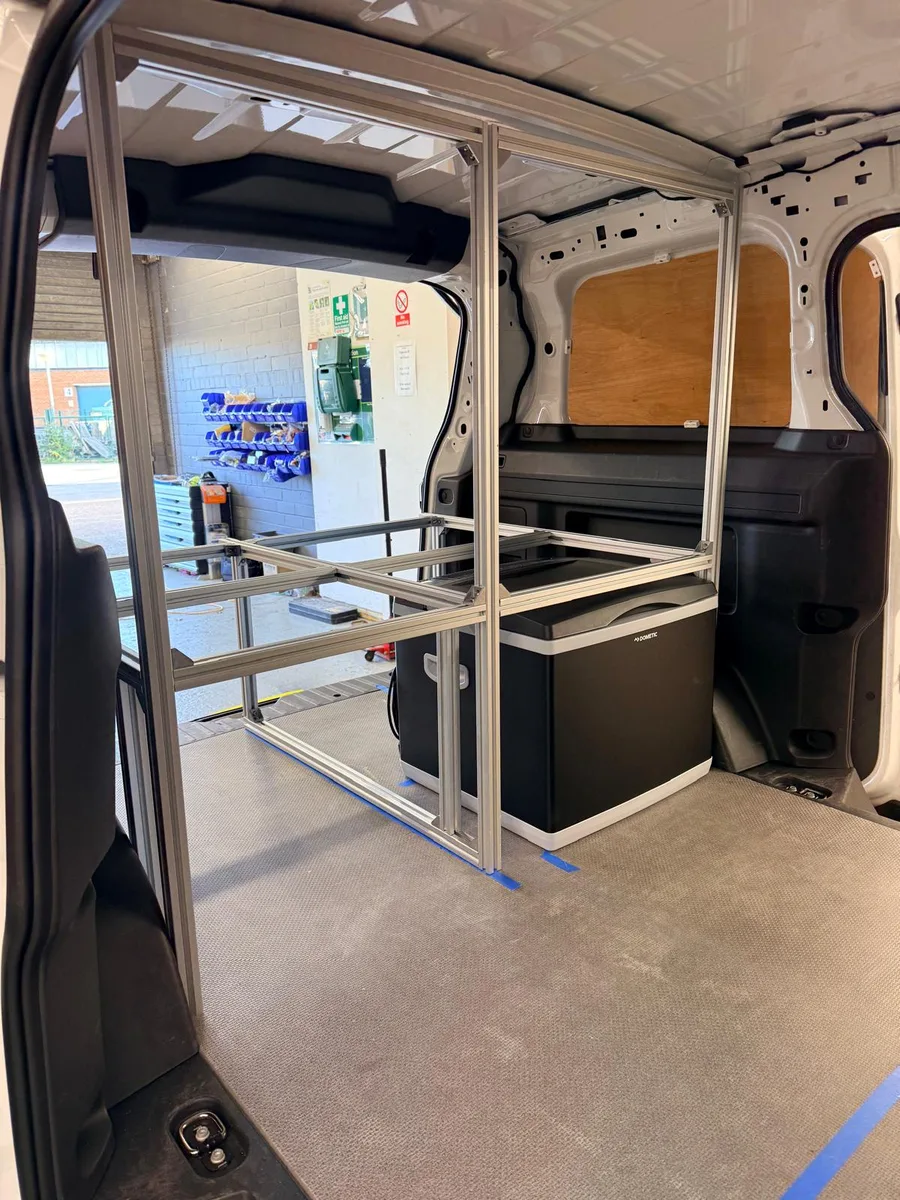
- Structure: 30 x 30 aluminium frame on adjustable feet, not carpentry. Bolted joints can be checked and re-tightened, and there's no timber to move with damp. Counter, electrical wall and battery frame form one structure.
- Pull-out serving station: about 910mm of counter on locking slides rated to 227kg. Locks out rigid for service, locks in for the road.
- Drawers: push-to-open, soft-close, no handles. Fronts fixed from behind, so no screws show.
- Syrup drawer: sized to Adam's bottles, with about 45mm to spare.
- Raised floor: about 160mm over the water tank, with a lift-out service hatch.
- Crate shelving: two slide-in levels at the driver's side door, plus the rack top.
- Finish: Adam's choice of black hex-faced board, routed and rounded edges showing the ply layers.
- Fridge: a 40-litre top-loading box that slides out from the cargo side.
Converting an electric van: mind the battery
The ID. Buzz has its main battery under the floor, so you can't just drill wherever you like. We followed VW's guidelines for converters from the first drawing, and nothing got drilled until we'd checked the spot.
We did things in a set order. The aluminium frame went in first, because nothing else could start without it. While the electrics went in, our carpenter built the drawers and shelving in his own workshop, so both could crack on at the same time with no dust anywhere near the wiring. Adam collected the van on Sunday 18 October 2026, 12 working days after it arrived.
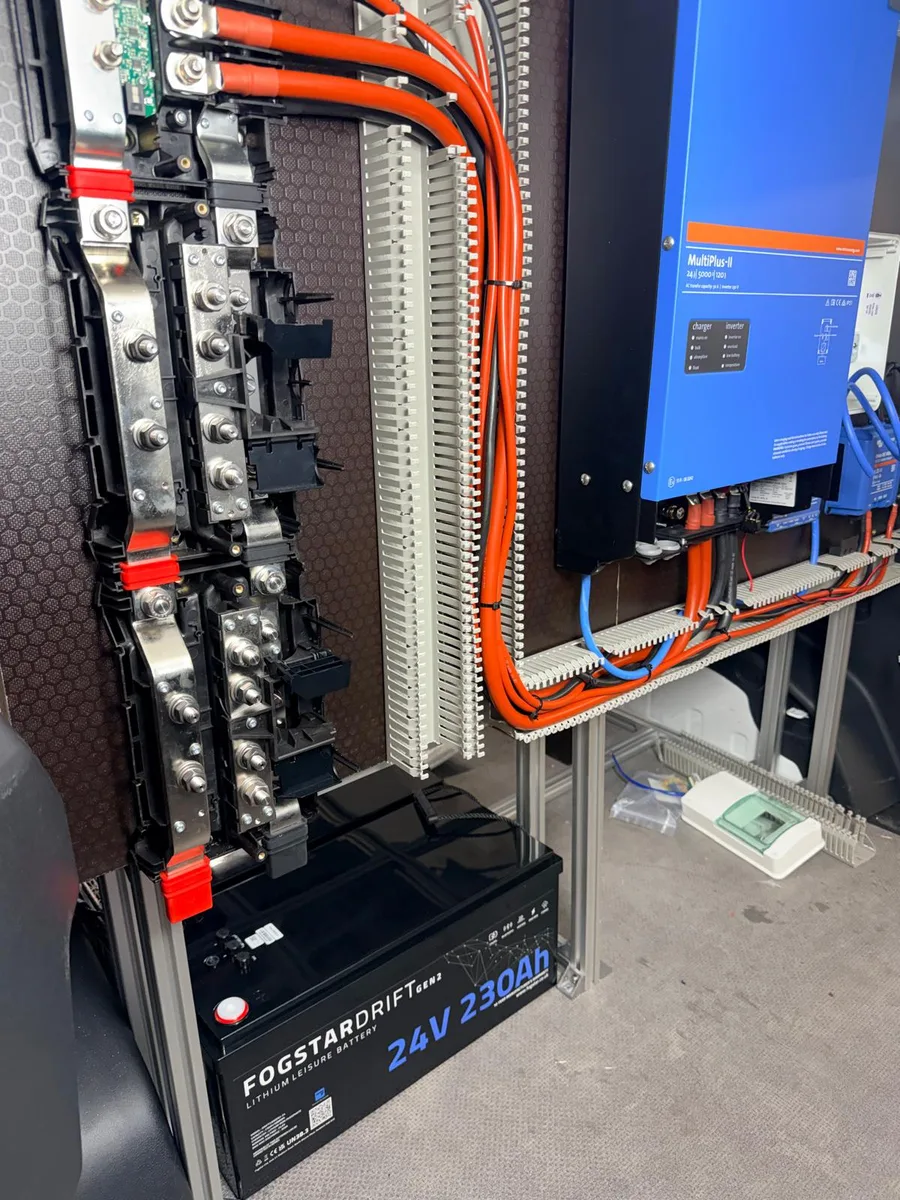
- Fixings: every point checked against VW's ID. Buzz converter guidelines before drilling, photographed before and after.
- Floor holes: only in VW's two approved zones at the rear. Machine drain, tank fill and tank vent all use them. Underbody inspected first, then every hole grommeted, treated and sealed.
- Water: 51-litre tank bolted through its own moulded inserts to the sub-frame, not drilled into the floor. Pressure fill through a quick-connector on an underbody bracket, so any overfill leaves through the approved zone, never inside the van.
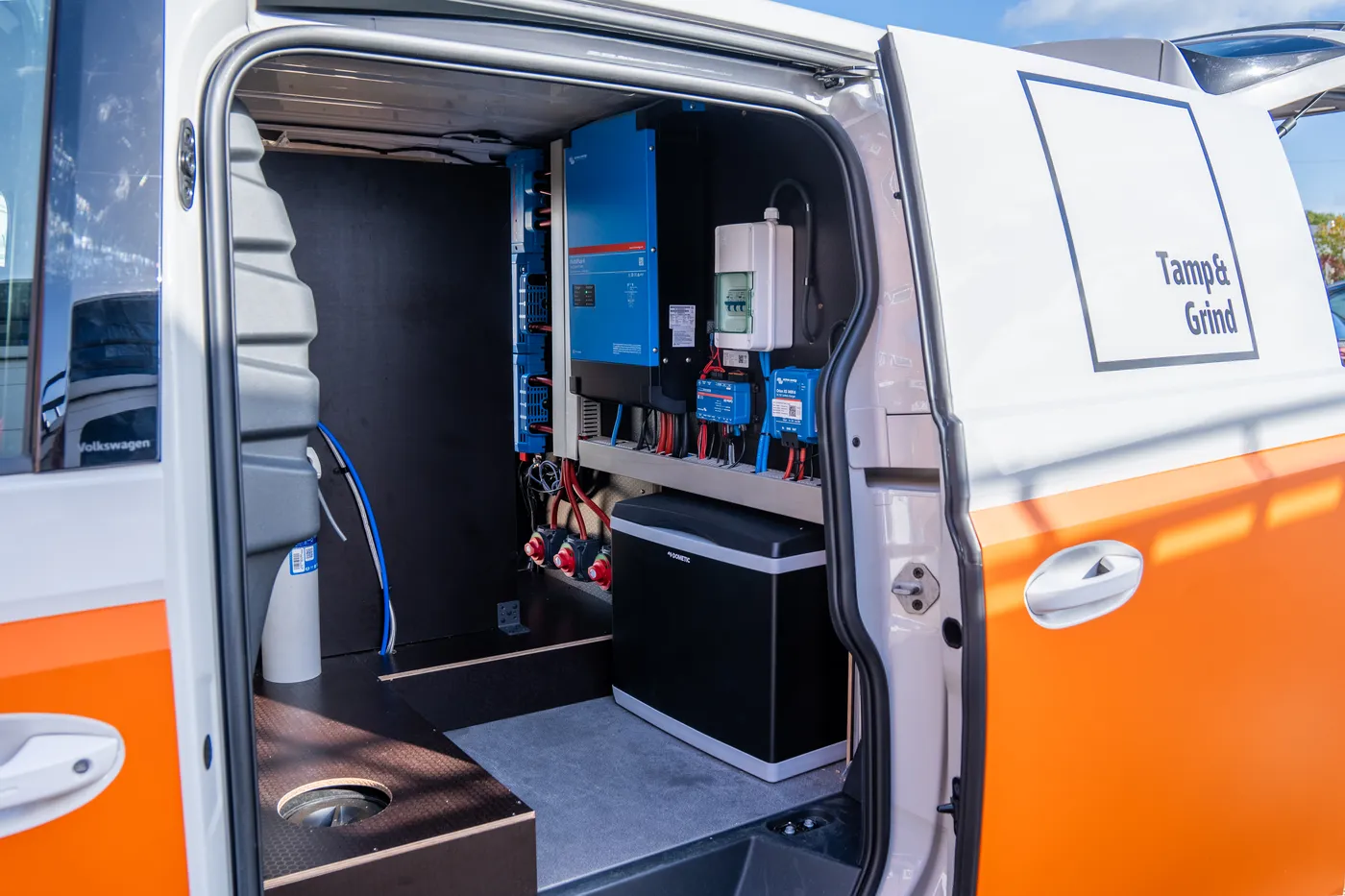
- Batteries: 114kg in an aluminium frame fixed to the vehicle structure, with a strut and side stop so they can't move in an emergency stop.

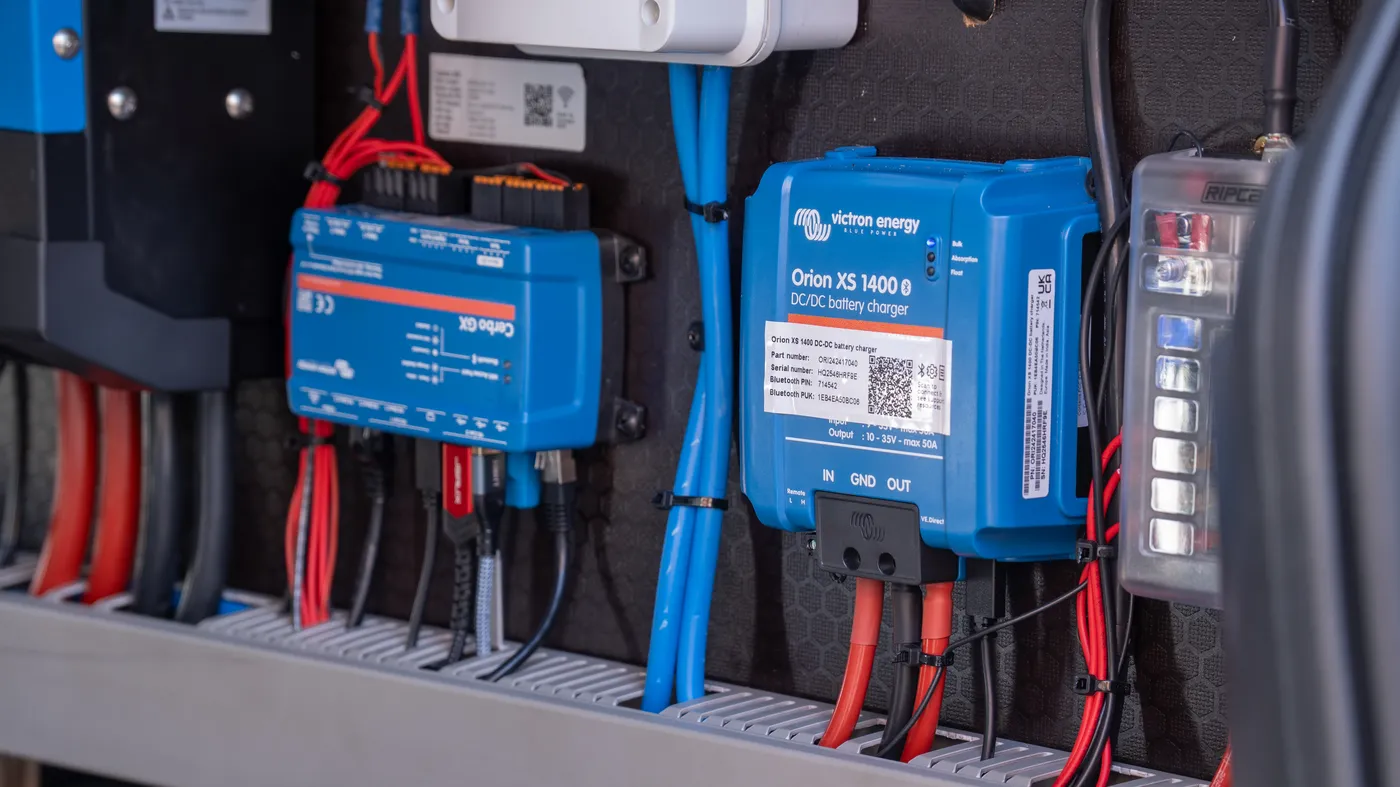
| Part | What it does |
|---|---|
| Victron MultiPlus-II 24/5000 inverter-charger | Runs the 230V side from the batteries. On a hookup, passes shore power through and charges at the same time. Mounted low in a ventilated bay away from the machine's heat, with a thermostatic fan |
| 3 x Fogstar Drift Gen2 24V 230Ah lithium | 17.7kWh nominal, about 114kg, in a purpose-built aluminium frame |
| Victron Lynx distribution, Class-T fusing | An isolator on every battery, so Adam can still trade with one switched out |
| Victron DC-DC charger | Tops up the batteries while driving. Limited to 30A, Volkswagen's maximum draw from the auxiliary battery, which gives back about 350W |
| Victron Cerbo GX, 5-inch touchscreen, phone app | State of charge, water level and an inverter temperature alarm by the machine. Charging timed to the off-peak tariff |
| 16A shore inlet, protected circuits | Inlet beside the van's own charge flap. Separate protected circuits for the inverter, the machine and a double socket |
Electrical work to BS 7671, certified by our electrical contractor, who holds NICEIC registration.
Out trading
No gas bottle in the back, and no generator by the queue. Adam's first event was in Hove. This is the message he sent us at the end of the day.
"Main positives from today: still had 67% battery when I finished. That's after making 80 coffees in 4.5 hours. Water tank still had 51%. I didn't run out of water, which was the important bit."Adam Moseley, Tamp & Grind Specialty Coffee
That first day he didn't quite start from a full charge. Once he'd been out trading, we adjusted a few settings, and the van now charges to 100% overnight. We also went back to sort a short snag list: a drawer catch, some edge trim, a light, and boxing in the water pump. That's what aftercare is for.
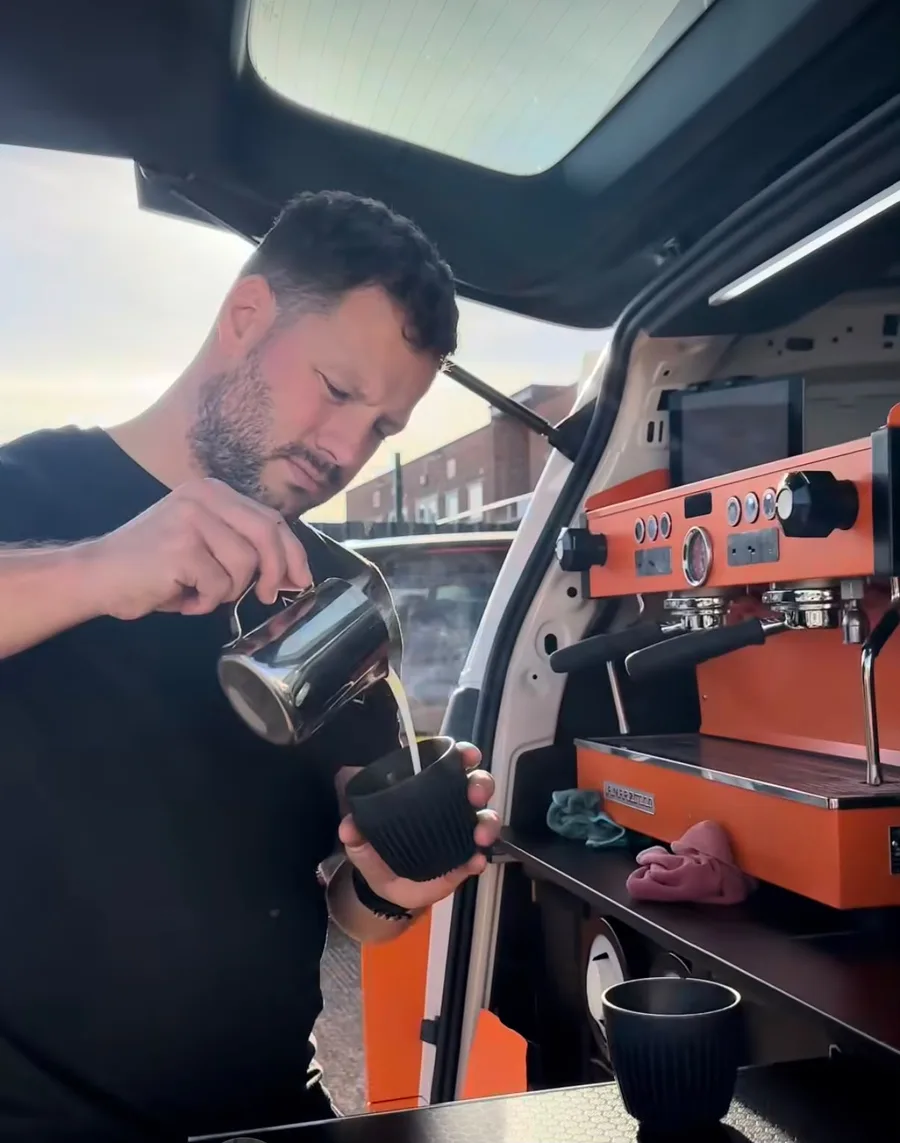
From Adam's Instagram
See the coffee van in Adam's reel.
Keeping an eye on it after handover
Our job doesn't stop when the van leaves. So we've built Wildbox Helios, our own panel for keeping an eye on the Victron systems we fit. With the owner's permission, we can see how the system's doing: battery charge, what's running, and temperatures.
- We can spot problems early. If a battery isn't charging fully or the inverter's running hot, we'll see it and give you a call before it costs you a day's trading.
- We can change settings remotely. If it's a settings issue, we can sort it through Victron's VRM portal while you're out on site.
- Only with your say-so. We only connect with your permission, and we won't change anything without telling you.
"We can monitor the systems remotely and, with the owner's permission, go into Victron's VRM portal and adjust settings while they're on site."Mark Cropley
Off-grid power for coffee vans and mobile traders: your questions
These are the questions we get asked most, by coffee vans and by every other kind of mobile trader who wants to get rid of the generator.
Coffee vans
Can you run a commercial espresso machine on batteries?
Yes, if the numbers are right. Adam's two-group machine runs from a 24V lithium bank through a 5kVA Victron inverter-charger, with the system designed around the machine at 3,600W. The trick is sizing the batteries for your coldest trading day, not an average one.
How much battery does a coffee van need?
It depends on your machine, how long you trade and what else is plugged in. For Adam's six-hour day we estimated about 11.2kWh, so we fitted 17.7kWh to leave enough margin on a cold morning. We work it out for your machine and your day before we quote.
Can you convert an electric van like the VW ID. Buzz?
Yes, but carefully. The main battery sits under the floor, so every fixing and every hole has to follow VW's converter guidelines. VW also limits how much extra equipment can draw from the van's 12V side.
Can a coffee van charge while it's driving?
A little. On the ID. Buzz, VW's 30 amp limit means about 350W back while driving. That's a bonus, not the plan. The main charge is overnight on mains, or from a hookup at an event.
What happens if the event has a hookup?
Plug in and the inverter passes mains straight through to the machine while it charges the batteries. The batteries only help out if the machine needs more than the hookup can give. A full refill from a 16A supply takes about four hours.
Any mobile trader
What mobile catering kit can run off batteries?
Anything that runs on 230V can, if the numbers add up. Kit that heats is the hardest: espresso machines, griddles, fryers and pizza ovens draw a lot of power for a long time. Fridges, lights, pumps, grinders and card machines are easy by comparison. We start with your kit list and your trading hours, and work out what it needs from there.
Battery or generator: what's the difference on the day?
- Quiet. No engine running next to your queue, and you can hear your customers.
- No fumes drifting over food or people.
- No fuel to buy, carry, store or top up halfway through service.
- No engine to service. No oil changes or pull cords.
- Power at the flick of a switch, charged at home overnight on a cheap tariff, or from a hookup when there is one.
Is it cheaper to run than a generator?
Day to day, by a long way. Here's a rough comparison for a six-hour day like Adam's:
- Battery: about 12kWh from the mains, including charging losses. On an off-peak EV tariff at around 7p per kWh, that's roughly £1. Check your own tariff, as rates vary.
- Generator: a 5.5kVA petrol inverter generator, big enough for an espresso machine, burns its 19.2 litre tank in about six and a half hours at full load. At this week's average petrol price, that's around £30 for a six-hour day. A coffee van won't run it flat out all day, so the real figure is lower. We can find no published part-load figure for that model, but even well below full load it's likely to be several pounds a day against about £1.
Figures: petrol at 172.78p per litre, UK average for the week of 2 November 2026 (GOV.UK weekly road fuel prices). Generator fuel figures from the Honda EU70iS specification sheet. Off-peak rate is a typical EV tariff in 2026, not Adam's own.
Why does a battery system cost more upfront?
Because you're buying all your power in advance. Lithium batteries, an inverter big enough for catering kit, and the protection that goes with them cost a lot more than a generator. What you get back is low running costs, a quiet pitch and less to think about on the day. How quickly it pays for itself depends on how often you trade. We'll work that out with you on your own numbers, and we won't promise a payback we can't show you.
What about solar?
It helps, but on a van roof it's a top-up, not the main source. For heavy kit like an espresso machine, the batteries and an overnight charge do the work. Adam's van has no solar at all.
Can you fit off-grid power to my existing van?
Yes. For lighter loads, our Powerframe is a pre-built, certified system on an aluminium frame. For heavy kit like a two-group espresso machine, we design the system around your kit, the way we did for Adam.
"Pretty much 99 per cent of it went exactly to plan, with a few tweaks along the way. That's down to the time Adam and I spent planning it out in advance: the drawings, the electrical schematics, all of it."Mark Cropley, founder, Wildbox Adventure Vehicles
A coffee machine is about as hungry as it gets, but we do it the same way whatever you want to run without a generator. Tell us what you need to power and for how long. We'll work out how much battery you need, what the van can carry and where the limits are, and you'll see all the working in your quote, just like Adam did. If you'd rather start from a system that's already designed and certified, have a look at Powerframe and our off-grid power page.