5 year warranty
On structure and installation, 12 months on finish and adjustment. Components carry their manufacturer's warranty.
Off-grid electrics · solar · West Sussex workshop
Solar that has stopped charging, a battery that will not last the weekend, or a van that needs a proper off-grid system. Our workshop in Partridge Green, West Sussex, finds the fault before changing parts, sizes systems from how you actually use the van, and builds to BS 7671, Section 721.
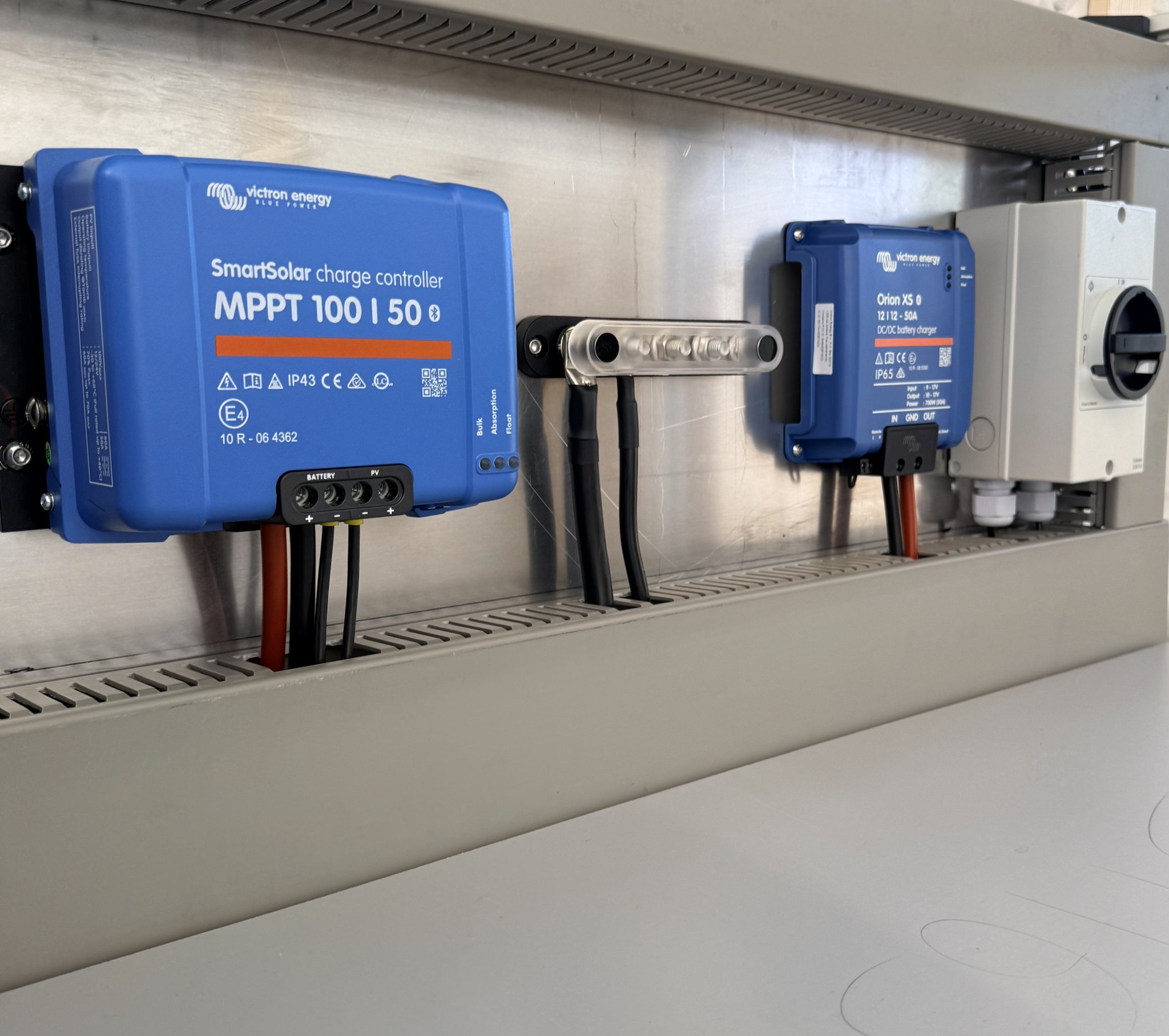
Hero photograph: Victron SmartSolar MPPT and Orion XS mounted on an aluminium plate.
On structure and installation, 12 months on finish and adjustment. Components carry their manufacturer's warranty.
The section for caravan and motor caravan electrical installations.
Fault-finding, upgrades and full systems on self-builds, conversions from other builders and our own.
£50 plus VAT for the first half hour of fault-finding, then £85 an hour plus VAT. We tell you plainly what it needs, what can wait and what it will cost.
Choose your starting point
We investigate faults across 12V DC and 230V AC systems, including batteries, inverters, battery-to-battery chargers, hook-up, lighting, USB, cameras and security.
If solar has stopped charging or output is not what you expect, we can look at the controller, connections and wider charging system before recommending what to do next.
Plan a change to battery capacity, solar, alternator charging or inverter provision around how you use the vehicle and the equipment already fitted.
Charging faults, a battery that is not keeping up, or a system ready for an upgrade. Our Partridge Green workshop works on campervan and motorhome habitation electrics, including self-builds and conversions from other builders. Workshop appointments in Partridge Green, West Sussex. We work on vehicles we have not built, including DIY and professional conversions.
Partridge Green. West Sussex workshop. 12V DC + 230V AC habitation electrics.
Previous service introduction: Solar repairs, off-grid fault-finding, considered upgrades and system planning for campervans and adventure vehicles. Tell us what the electrics are doing, or start with the Powerframe 3000 and sizing tool.
Solar fault or planned upgrade? You can contact the workshop directly without completing the sizing tool.
Tell us what is happening, what is already fitted and when you need the vehicle. We assess the work, explain the options and agree the repair before booking it into the workshop.
The original repair or diagnose description was: Solar, batteries, inverter/chargers and other habitation electrical faults. The upgrade description was: Check how the new parts work with the existing installation before changing it. The Powerframe 3000 description was: See the pre-built system, its specification and what fitting involves. Its original link label was View Powerframe details.
Three planning examples show how the loads you choose shape a first-pass system.
| Load | Watts | Effective hours/day | Wh/day |
|---|---|---|---|
| Compressor fridge | 45 | 7 | 315 |
| LED lights | 15 | 4 | 60 |
| Water pump | 40 | 0.25 | 10 |
| Laptop charging | 65 | 2 | 130 |
| Phones / cameras | 30 | 1 | 30 |
| Travel kettle, not a domestic 2kW+ kettle | 1000 | 0.1 | 100 |
Raw daily total: 645 Wh. With 12% general losses and the tool's total rounding: 722 Wh/day.
Effective hours are consumption allowances, including fridge duty cycling, not promises of continuous operation.
Battery: Fogstar Drift 12V 230Ah; 1 bank; 2944 Wh nominal; 2649.6 Wh usable; 12 V system.
Days with no charging, modelled figure: 3.7. Target: 2 unsupported days.
Solar: 200 W through Victron SmartSolar MPPT 75/15. Inverter: Victron MultiPlus 12/1600/70.
Vehicle charging: Victron Orion XS 12/12-50A, 700 W effective, 50 A.
| Load | Watts | Effective hours/day | Wh/day |
|---|---|---|---|
| Compressor fridge | 45 | 7 | 315 |
| LED lights | 15 | 4 | 60 |
| Water pump | 40 | 0.25 | 10 |
| Laptop charging | 65 | 2 | 130 |
| Phones / cameras | 30 | 1 | 30 |
| Satellite internet | 60 | 4 | 240 |
| Microwave (short use) | 900 | 0.0833 | 75 |
| Travel kettle, not a domestic 2kW+ kettle | 1000 | 0.1 | 100 |
Raw daily total: 960 Wh. With 12% general losses and the tool's total rounding: 1075 Wh/day.
Effective hours are consumption allowances, including fridge duty cycling, not promises of continuous operation.
Battery: Fogstar Drift 12V 230Ah; 1 bank; 2944 Wh nominal; 2649.6 Wh usable; 12 V system.
Days with no charging, modelled figure: 2.5. Target: 2 unsupported days.
Solar: 0 W, none selected. Inverter: Victron MultiPlus 12/1600/70.
Vehicle charging: Victron Orion XS 12/12-50A, 700 W effective, 50 A.
Battery: Fogstar Drift 12V 230Ah; 2 banks; 5888 Wh nominal; 5299.2 Wh usable; 12 V system.
Days with no charging, modelled figure: 4.9. Target: 4 unsupported days.
Solar: 0 W, none selected. Inverter: Victron MultiPlus 12/1600/70.
Vehicle charging: Victron Orion XS 12/12-50A, 700 W effective, 50 A.
No-charge days range, modelled figures: 2.5 to 4.9.
All-day Starlink and e-bike charging are not included and need their own allowance.
| Load | Watts | Effective hours/day | Wh/day |
|---|---|---|---|
| Compressor fridge | 45 | 7 | 315 |
| LED lights | 15 | 4 | 60 |
| Water pump | 40 | 0.25 | 10 |
| Laptop charging | 65 | 2 | 130 |
| Phones / cameras | 30 | 1 | 30 |
| Satellite internet | 60 | 4 | 240 |
| Single induction hob ring | 1800 | 0.5 | 900 |
Raw daily total: 1685 Wh. With 12% general losses and the tool's total rounding: 1887 Wh/day.
Effective hours are consumption allowances, including fridge duty cycling, not promises of continuous operation.
Selected battery bank: 300 Ah at 24 V (25.6 V nominal for energy calculations).
Battery: 2 × Fogstar Drift 12V 100Ah in series (24V 100Ah); 3 banks; 7680 Wh nominal; 6912 Wh usable; 24 V system.
Usable energy and no-charge days: 25.6 V × 300 Ah = 7680 Wh nominal; × 0.9 usable fraction = 6912 Wh usable; ÷ 1887 Wh/day = 3.7 days (modelled, rounded to one decimal place).
Days with no charging, modelled figure: 3.7. Target: 3 unsupported days.
Solar: 600 W through Victron SmartSolar MPPT 100/30. Inverter: Victron MultiPlus-II 24/3000/70-32.
Vehicle charging: Victron Orion XS 1400 (12V to 24V, derated), 700 W effective, 25 A.
These are planning examples, not a promise of what every van will achieve.
Illustrations of how use changes a first-pass specification, not completed customer installations or final engineering plans.
From about £2,250 + VAT
A planning estimate. We confirm the price in writing after we have seen the van.
The planning tool
Choose real-world loads. The tool then selects named battery, inverter/charger, DC-DC and solar-controller combinations and checks the battery current limit.
Small upgrades from about £550 plus VAT. A full system, with battery, inverter, solar and charging, from about £2,250 plus VAT. These figures are for upgrades and new systems. Repair work is quoted in writing before it starts. The estimate below updates as you choose. It is a planning estimate, not a quote, and we check the van before we confirm a price in writing.
You can change any answer before sending the result.
UK winter reality
For a modest 200 W roof setup, this illustrative model gives about 120 Wh/day in January and about 560 Wh/day on a good summer day. Clouds, shade, low sun and where the van is parked can reduce either figure.
A planning example, not a forecast for a particular roof or a promise of days off-grid.
Illustrative energy from 200 W of solar
Illustrative yield for a modest roof setup. Actual output varies with weather, shade, orientation and charging conditions.
Keep your sizing result
Send the assumptions and calculated specification to the workshop. We will be clear about what still needs checking.
Checks before parts
Designing around a domestic kettle/induction then balking at cost and weight.
Use the 1,000 W travel-kettle option or choose a cooking strategy before choosing an inverter.
Assuming summer solar output will hold in November.
Model January separately and keep a charging plan.
Checking inverter continuous output but not battery surge current.
Check inverter peak watts against the battery bank's maximum continuous BMS discharge current.
No plan for cold-weather charging of LiFePO₄.
Check the battery BMS and prevent charging below its allowed temperature.
Quoting an Orion XS 1400 at full power across mixed voltages.
A 12 V to 24 V installation is limited to roughly 700 W by the 50 A input/output limits.
Under-fusing or using cable that is too small.
Set protection around current, length, routing and installation method.
Good to know
Start with daily watt-hours, then choose the unsupported days, battery reserve, solar space and charging sources. The tool shows its assumptions.
Divide the nominal battery watt-hours by the assumed system voltage. The useful figure is the usable portion of that nominal capacity, not the label alone.
Size the inverter for the AC appliances that will run at the same time, allowing for startup demand and checking battery discharge limits. If appliances are used one at a time, start with the largest load; work equipment may run concurrently. Do not treat VA and watts as interchangeable.
You can, if you understand isolation, fusing, cable routing, charging equipment, battery temperature limits and testing. Final protection should be checked by someone competent.
It means the installed system has been inspected and tested against the relevant requirements by an appropriately qualified person. It is not the same as a component having a CE mark.
Use the roof you actually have. A clear roof may allow around 500 W in this planning model; shade and obstructions reduce the result.
Yes, but January yield is roughly a quarter of a good summer day in this simple model, and it is not guaranteed.
Combustion vans often benefit from one. Electric vehicles and trailers need a vehicle-specific approved charging interface or a different charging plan.
Final selection needs current, cable length, route, temperature and equipment instructions. The tool flags the planning current but is not installation sign-off.
Yes. Choose work and select the loads used on a normal day; tool charging can change the inverter and current requirement quickly.
A ready-built option
Pre-built off-grid electrics
About 58 kettle boils, or 7 air-fryer sessions, from one full charge.
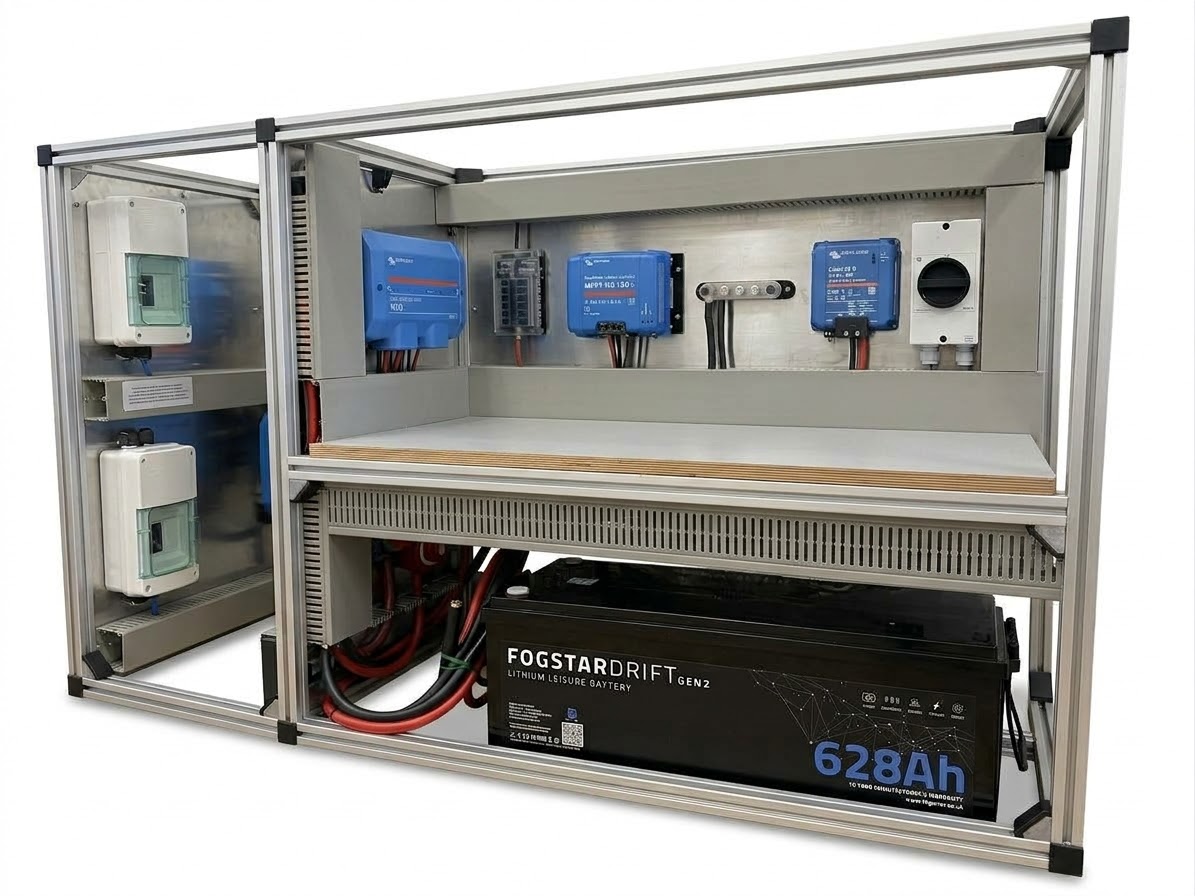
Our pre-built off-grid system: a 3000VA inverter/charger, 8 kWh of lithium, alternator and solar charging and full protection on one aluminium frame, bench-tested in Partridge Green and built to BS 7671, Section 721. £5,627 plus VAT (£6,752.40 including VAT). Fitting, solar panels and monitoring are quoted separately.
Planning examples, not a promise. Details and assumptions are on the Powerframe page.
Bench-tested in our Partridge Green workshop, with a Victron MultiPlus-II 3000VA inverter/charger, Fogstar Drift Gen2 628Ah battery and hardware for alternator and solar charging. Vehicle fitting, solar panels and monitoring are quoted separately.
Workshop support · Partridge Green
Our workshop is in Partridge Green, near Horsham, West Sussex.
Solar not charging, a battery that will not hold charge, an inverter fault or a system you would like to improve? Tell us about the van and we will work out the right next step.
Diagnostic fault-finding is £50 plus VAT for the first half hour, and £85 an hour plus VAT beyond that.
Use the relevant equipment documentation when checking component limits. Solar and runtime figures on this page are Wildbox planning estimates, not manufacturer guarantees.